





Read the Full Series
This article is one part of a walkthrough detailing how we recreated an NXP i.MX 8M Mini–based computer using Quilter’s physics-driven layout automation.
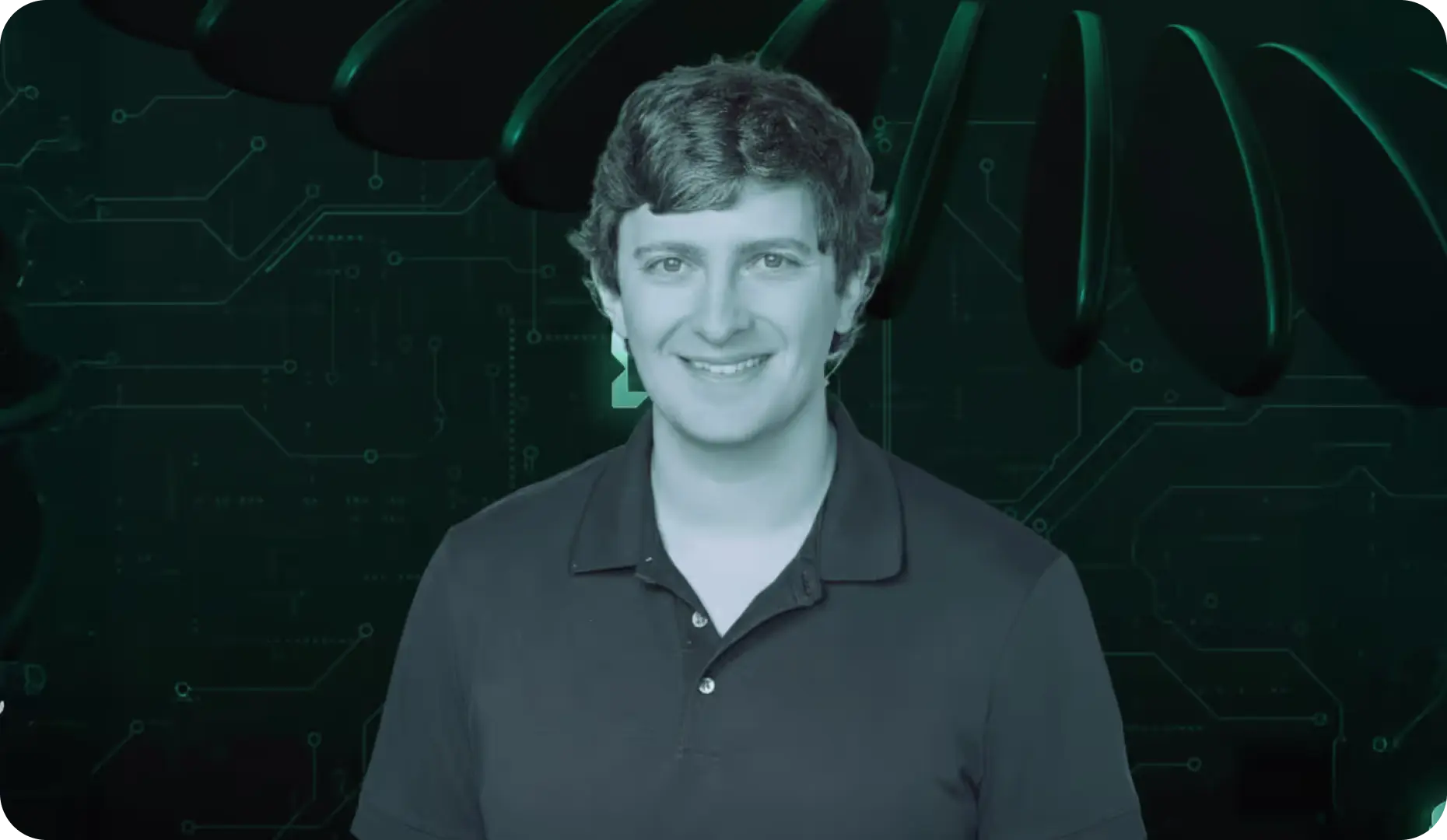
For Nick Faughey, software engineering has always been about people as much as systems. “I want to stay under Dunbar's number always. I want to know everybody's name of the company,” he explains. After nearly a decade across startups, Nick has built his career not just on technical mastery but on a hunger for agility—the ability to have an idea today and see it live tomorrow. In this Humans in the Loop feature, we explore how Nick brings that ethos to Quilter, balancing the challenges of infrastructure at scale with the culture of a small, fast-moving team.

Origins
Nick’s story begins in high school with a serendipitous stumble. “Probably not a super unique story, but back in high school, stumbling across some self taught software course on the Internet or something. And I was like, hey, that's neat.” Those early online experiments led him to study computer science at the University of Pittsburgh, where he graduated in 2017. From the start, Nick gravitated to environments where the spark of curiosity mattered more than bureaucracy. He wasn’t drawn to big organizations where ideas languish in multi-month approval cycles. “I just can't stand the whole thing like I have an idea but now I need to send it through three levels of approvals and two write ups and wait for the next quarterly planning.”
Instead, Nick found his way into startups—six or seven by his count—where wearing “a bajillion hats” was the norm. The draw wasn’t just technical challenge, but the immediacy of seeing an idea come alive without red tape.
Journeys in Engineering
Over the years, Nick’s path has stayed consistent: small teams, fast decisions, and hands-on building. “It's always been the fast paced, small, tiny little team wear a bajillion hats type of work,” he says. That preference carried into his work at Quilter, where infrastructure demands take on an unusual rhythm. Unlike traditional SaaS growth curves—steady traffic that scales predictably—Quilter’s workload is spiky.
“Our baseline infrastructure is very little. The thing kind of just sits there. But then as soon as you submit a board to route, we spin up like hundreds of servers in the background… and then they spin all the way back down to zero.”
That zero-to-a-bajillion cycle presents unique engineering puzzles. It isn’t just about scaling up with brute force—it’s about designing systems that gracefully expand and contract, cleaning up behind themselves. “Sometimes it's more about how to creatively apply an established pattern to some Quilter specific problem,” Nick reflects. He likens infrastructure work to drawing from a stack of known solutions, yet applying them with nuance in novel contexts.
Why Quilter?
For Nick, Quilter represents the best of both worlds: deep technical puzzles and the culture of speed and agency. “The cool thing is how spiky our infrastructure is,” he notes, pointing out how rare it is to tackle such challenges outside of specialized domains. More importantly, the culture resonates: “It comes back to like the whole fact that like we have an idea and it can be done tomorrow. Like there's not the three months of bureaucratic red tape.”
Nick also sees a broader significance in bridging infrastructure and software science. “The moat between pure sciency software engineering and getting what you built out in front of the customers is kind of growing. There's so much complexity in there.” To him, part of Quilter’s value is encouraging engineers to close that gap—to understand enough infrastructure to get their innovations into the hands of users.
Beyond the Workbench
When Nick isn’t solving infrastructure puzzles, he’s planning his next adventure. “Usually it's just planning the next travel. So I tend to do a lot of international travel.” He’s explored much of Europe, along with destinations in Asia and Africa. Favorites include Greece—“you feel like you're stepping into, like, an amusement park because… everything feels like it's 1800 years old”—and Japan, where “it feels like a video game… walking around Tokyo, there's just so much hustle and bustle.”
His food tastes are simple but indulgent: “I like a simple surf and turf. That's my go to. Just a nice filet and lobster.” Sushi, he admits, is up there too. Travel, exploration, and the occasional perfect meal round out his life beyond code.
A Line to Remember
“The bridge between typing code and having that code in front of customers is just getting bigger every day.”